
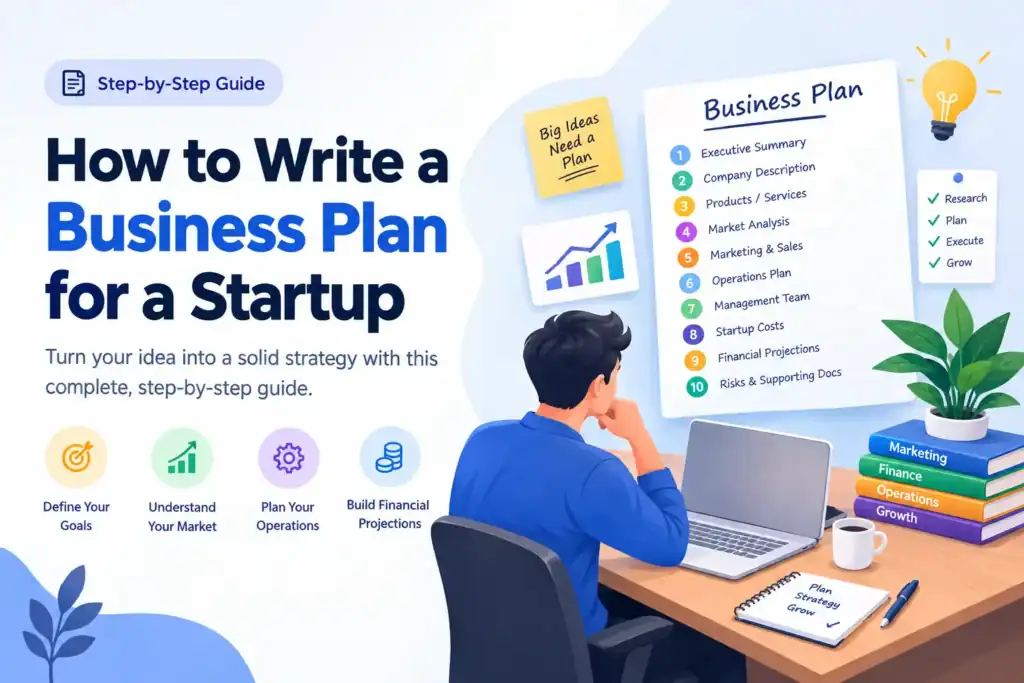
Starting a business is exciting, but learning how to write a business plan for a startup can help you turn your idea into a practical strategy. Before investing time and money, you need to understand your customers, evaluate the competition, estimate costs, and decide how your business will generate revenue.
This guide explains how to write a business plan for a startup, from researching your market to preparing realistic financial projections.
A successful startup business plan helps you turn your idea into a practical strategy, set clear goals, and prepare realistic financial projections.
Table of Contents
- What Is a Business Plan?
- Why Does a Startup Need a Business Plan?
- Step 1: Write an Executive Summary
- Step 2: Describe Your Company
- Step 3: Explain Your Products or Services
- Step 4: Analyze Your Market and Competition
- Step 5: Create a Marketing and Sales Strategy
- Step 6: Develop an Operational Plan
- Step 7: Define Your Management Team
- Step 8: Calculate Your Startup Costs
- Step 9: Prepare Your Financial Projections
- Step 10: Identify Risks and Supporting Documents
- Common Business Plan Mistakes to Avoid
- Business Plan Checklist for Startups
- Frequently Asked Questions
- Final Thoughts
What Is a Business Plan?
A business plan is a written document that describes a business idea, its target customers, products or services, operating model, marketing strategy, and financial expectations.
It helps founders think through the practical requirements of launching and managing a business. It can also communicate a business opportunity to potential lenders, investors, partners, and team members.
A useful business plan is more than a description of what you hope to achieve. It explains how you intend to achieve your goals and what evidence supports your decisions.
For example, instead of simply writing, “Our business will become a market leader,” explain which customers you will target, what makes your offer different, how you will reach those customers, and which milestones will help you measure progress.
A clear business plan for a startup helps founders organize their goals, estimate costs, and make informed decisions before launch.
Why Does a Startup Need a Business Plan?
Writing a business plan helps you make informed decisions before committing significant resources. It also gives you a framework for testing assumptions and tracking progress.
1. Test Your Business Idea
Researching customers and competitors can help you determine whether people genuinely need your product or service. It may also reveal a more promising customer segment or a better way to position your offer.
For more inspiration, explore these new business ideas for 2026 and compare them with your skills, budget, and target market.
2. Understand Your Target Customers
Understanding your customers helps you decide what to sell, how to price it, and where to promote it. Without this information, you could spend money trying to reach people who are unlikely to buy.
3. Estimate Your Startup Costs
A business plan encourages you to identify expenses such as equipment, software, inventory, registration, marketing, and working capital. This makes it easier to estimate how much money you may need before launch.
4. Plan How Your Business Will Make Money
Your plan should explain your revenue sources, pricing model, expected sales, and major expenses. These details help you assess whether your business model could become financially sustainable.
5. Prepare for Financing
Lenders and investors may request a business plan to understand your business model, funding requirements, financial assumptions, and potential risks. A plan does not guarantee financing, but it can help you present your proposal clearly.
6. Measure Progress
Once your business begins operating, you can compare actual results with your original goals. If sales are lower than expected or expenses rise, your plan can help you identify where adjustments are needed.
Step 1: How to Write a Business Plan for a Startup — Executive Summary
The executive summary provides a concise overview of your entire business plan. It introduces the business opportunity and highlights the most important information readers need to understand.
Although it appears at the beginning of a business plan, it is usually easier to write this section after completing the other sections.
A clear business plan for a startup helps founders organize their goals, estimate costs, and make informed decisions before launch.
Your executive summary should cover the following points:
- Business idea: What business are you starting, and what customer need does it address?
- Products or services: What will you offer?
- Target market: Who are your ideal customers?
- Revenue model: How will your business earn money?
- Competitive advantage: Why might customers choose your business over alternatives?
- Marketing strategy: How will you attract customers?
- Business goals: What do you want to accomplish in the first year and beyond?
- Financial outlook: What are your estimated costs, revenue expectations, and funding requirements?
- Progress so far: Have you tested your product, gained early customers, or received useful feedback?
Keep the summary focused on the facts that matter most. Avoid unsupported claims, lengthy background information, and financial promises you cannot justify.
Example of an Executive Summary
Imagine you want to launch a digital marketing agency serving small businesses.
Your executive summary might explain that the agency will help local service providers improve their online visibility through website optimization, content marketing, and search engine optimization. The business will initially operate remotely and earn revenue through project fees and monthly service packages. Potential clients will be reached through referrals, educational content, and targeted outreach.
This example gives readers a basic understanding of the business without requiring them to read every section first.
Step 2: Describe Your Company
The company description explains what your business does, whom it serves, how it is structured, and what it aims to accomplish.
Business Name and Structure
State your proposed business name, location, ownership, and legal structure. Depending on your country and circumstances, possible structures include a sole proprietorship, partnership, limited liability company, or corporation.
Legal structures have different tax, liability, reporting, and ownership implications. Research the requirements in your jurisdiction and seek qualified professional advice when necessary.
Mission Statement
A mission statement explains why your business exists, what it does, and whom it serves.
For example:
“Our mission is to help small businesses strengthen their online presence through affordable, practical, and results-focused digital marketing services.”
A useful mission statement is clear enough for customers, employees, and business partners to understand your purpose.
Vision and Values
Your vision describes what you hope the business will become over time. Your values explain the principles that guide decisions, such as customer service, transparency, quality, and responsible innovation.
For example, a startup might aim to become a trusted provider in its industry while maintaining transparent pricing and responsive customer support.
Goals and Milestones
Set measurable goals rather than relying on general statements.
For example, a startup might aim to:
- Interview 20 potential customers before launch.
- Secure its first five paying clients.
- Reach a defined monthly revenue target within 12 months.
- Introduce an additional service after validating customer demand.
These are examples, not universal targets. Set milestones according to your resources, market, and business model.
Step 3: Explain Your Products or Services
This section describes exactly what you plan to sell, how you will deliver it, and why customers may find it valuable.
Start by explaining the problem your product or service solves. Then describe how your offer addresses that problem.
Consider these questions:
- What exactly will customers receive?
- Which problem or need does it address?
- What are its main features and benefits?
- How will it be produced or delivered?
- How much will it cost to provide?
- How will you charge customers?
- What makes your offer different from available alternatives?
- Are there important suppliers, licenses, or technical requirements?
Identify Your Unique Selling Proposition
Your unique selling proposition (USP) explains why a customer might choose your business over competing options.
A USP does not require an entirely new product. Your business might stand out through specialized expertise, faster delivery, clearer communication, better customer support, a convenient service model, or a focus on an underserved audience.
For example, a bookkeeping service could specialize in independent online retailers rather than trying to serve every type of business.
Be specific about the advantages you can genuinely deliver. Avoid claiming that your product is the best or cheapest unless you can substantiate that claim.
Develop a Pricing Strategy
Your pricing should reflect your costs, customers’ willingness to pay, competitor offerings, and the position you want your brand to occupy.
Common pricing approaches include:
- Cost-plus pricing: Add a target margin to your costs to determine your selling price.
- Value-based pricing: Set prices according to the value customers perceive in your product or service.
- Competitive pricing: Compare prices for similar products or services in your market.
- Subscription pricing: Charge customers a recurring fee for continued access to a product or service.
Know your costs before setting a price. High sales volume does not necessarily mean a healthy business if each sale contributes little or nothing toward operating expenses.
Step 4: Analyze Your Market and Competition
Market research helps you determine whether your business idea has a realistic opportunity. It can also reveal customer needs, pricing expectations, and gaps in the market.
Do not base your conclusions solely on personal opinions or assumptions. Gather evidence from potential customers, competitors, industry publications, government sources, and relevant market reports.
Identify Your Target Market
Your target market is the specific group of customers most likely to need, value, and purchase your product or service.
For consumer businesses, consider factors such as location, age range, needs, preferences, and purchasing behavior.
For business-to-business companies, examine industry, company size, business stage, budget, and the challenges potential clients need to solve.
You do not need to target everyone. Defining a clear customer group can help you make better decisions about product development, pricing, and marketing.
Validate Customer Demand
Speak directly with potential customers where possible. Ask about their current challenges, how they solve them, what frustrates them, and what influences their purchasing decisions.
You can also test demand with a simple landing page, a prototype, a sample service, or a small pilot project.
Positive feedback is useful, but actual purchasing behavior provides stronger evidence than compliments alone. Look for signs that customers are willing to spend money or make a meaningful commitment to solve the problem.
Analyze Your Competitors
Every business competes with alternatives. These may be direct competitors selling similar products or indirect competitors solving the same customer problem in another way.
Compare competitors on factors such as:
- Products and services
- Pricing and payment terms
- Target customers
- Customer reviews
- Quality and service
- Website and online visibility
- Distribution channels
- Strengths and weaknesses
Use this research to identify opportunities for differentiation rather than simply copying another company’s strategy.
For example, a small business may not be able to compete with a large company on price alone. It might instead focus on a specific customer group, more personalized service, or a simpler buying experience.
Step 5: Create a Marketing and Sales Strategy
A marketing and sales strategy explains how you will reach potential customers, communicate the value of your offer, and turn interest into sales.
Your approach should reflect your audience, budget, business model, and competitive position.
Choose Your Marketing Channels
Depending on your business, suitable marketing channels may include:
- Search engine optimization (SEO)
- Educational blog posts and other content marketing
- Social media
- Email marketing
- Paid search or social advertising
- Referral programs
- Partnerships and networking
- Online marketplaces or local business directories
- Industry events and direct outreach
You do not need to use every channel at once. Start with the channels most relevant to your audience and available budget.
For example, a local service business may benefit from a well-optimized website, local search visibility, customer reviews, and referrals. A business selling digital products internationally may focus more on search content, email marketing, and relevant online communities.
Define Your Sales Process
Explain how someone moves from discovering your business to becoming a paying customer.
For example, a service business might publish useful articles, invite readers to request a consultation, provide a proposal, and follow up with interested prospects.
A product business might attract visitors through search and social media, offer detailed product information, answer common questions, and make purchasing straightforward.
A clear sales process helps you identify where potential customers lose interest and where improvements may be needed.
Set a Marketing Budget
Estimate both initial marketing expenses and ongoing costs. Include website development, creative materials, advertising, software, and any external services you expect to use.
Track meaningful results such as qualified leads, conversion rate, customer acquisition cost, repeat purchases, and revenue. Use those results to decide which activities deserve more investment.
Avoid assuming that every marketing campaign will produce immediate profit. Test your approach, measure the results, and adjust your budget as you learn.
Step 6: Develop an Operational Plan
The operational plan explains how your business will function day to day. It covers the resources, systems, and processes needed to deliver products or services reliably.
Production and Service Delivery
Explain how you will create a product or deliver a service from the initial order to completion.
For a consulting business, this could include customer onboarding, research, project delivery, quality checks, and follow-up.
For a physical product business, it may involve sourcing materials, production, packaging, inventory management, and shipping.
Estimate the time and cost involved in delivering your product or service. Understanding these details helps you assess your capacity and profitability.
Location and Equipment
Describe whether the business will operate from home, a commercial space, a shared office, or a remote location.
List the equipment, software, internet access, and other resources needed to operate. Identify any relevant zoning rules, licenses, permits, or industry-specific requirements.
The requirements will vary according to your business model and location. Check applicable local rules before making major commitments.
Suppliers and Inventory
If your business depends on suppliers, identify key vendors and explain how you will manage ordering, delivery, payment terms, and potential disruptions.
Businesses that carry inventory should estimate stock requirements, storage costs, supplier lead times, and replenishment procedures.
Where practical, identify alternative suppliers for essential materials or products. A backup plan can help reduce the impact of delays or shortages.
Quality Control and Risk Management
Describe how you will maintain consistent quality, protect customer information, handle complaints, and respond to interruptions.
Depending on the business, you may also need appropriate insurance, backup suppliers, secure data backups, and documented operating procedures.
Review your processes regularly to identify problems before they affect customers or increase costs.
Step 7: Define Your Management Team
This section explains who will run the business and which skills are needed to execute the plan.
If you are launching alone, describe your relevant experience and responsibilities. You do not need to invent a management team to make the business plan look impressive.
Include the following information where relevant:
- Founder and owner responsibilities
- Relevant industry knowledge and professional skills
- Key employees or planned hires
- Freelancers, contractors, or external specialists
- Advisors, accountants, legal professionals, or mentors
- Important skills you still need to acquire or obtain
Be honest about gaps. If you lack experience in accounting, sales, technology, or operations, explain how you will address that gap through training, professional support, or future hiring.
For example, a founder with strong product knowledge but limited accounting experience might use bookkeeping software and consult an accountant when preparing financial statements or tax documents.
Step 8: Calculate Your Startup Costs
Before launching, estimate how much money you will need to prepare the business and support its early operations.
Potential startup expenses include:
| Expense Category | Examples |
|---|---|
| Registration and compliance | Registration fees, licenses, and permits |
| Equipment | Computers, machinery, and furniture |
| Technology | Website development, software, and hosting |
| Inventory and supplies | Initial stock, raw materials, and packaging |
| Marketing | Branding, launch materials, and initial campaigns |
| Professional services | Accounting, legal advice, and consulting |
| Premises | Deposits, setup costs, and initial rent |
| Working capital | Cash available to cover early operating expenses |
Your actual expenses will depend on your business model and location. Obtain supplier quotations where possible and document how you estimated each amount.
Include a Contingency Reserve
Unexpected costs can arise during setup and launch. Consider adding a contingency reserve based on the uncertainty and risk involved.
The SCORE business plan template suggests considering a reserve of around 20–25% of estimated startup costs. Treat this as a planning guideline rather than a fixed requirement. The appropriate amount depends on your business, available funds, and potential risks.
Identify Your Funding Sources
Explain how you expect to finance the business. Possible sources include personal savings, business revenue, loans, outside investment, or other funding arrangements available to you.
If you plan to seek financing, specify the amount required, how it will be used, and how it is expected to support the business.
Avoid requesting more money than your documented plan requires. A clear explanation of funding needs and expected outcomes makes your proposal easier to evaluate.
Step 9: Prepare Your Financial Projections
Financial projections help you evaluate whether your business model could become sustainable.
Your estimates should be based on documented assumptions about customer demand, pricing, sales volume, operating expenses, and payment timing.
Create a Sales Forecast
Estimate how many potential customers you expect to reach, the proportion likely to purchase, and the average value of each transaction.
For example, suppose a business expects 100 qualified leads in a month, converts 5% into paying customers, and earns an average of $200 per customer.
Its illustrative monthly revenue would be:
100 leads × 5% conversion rate × $200 average transaction value = $1,000
This is a hypothetical calculation, not a prediction. Your actual assumptions should be supported by research, early sales, pilot results, or reasonable industry benchmarks.
If your business has multiple revenue sources, estimate each source separately before calculating total projected revenue.
Prepare a Profit and Loss Projection
Estimate revenue, direct costs, operating expenses, and expected profit or loss over a defined period.
A profit and loss projection may include:
- Revenue from products or services
- Cost of goods sold or direct service costs
- Gross profit
- Operating expenses
- Interest and other relevant expenses
- Estimated taxes, where applicable
- Net profit or loss
Remember that revenue is not the same as profit. A business can generate substantial sales and still be unprofitable if its costs are too high.
Prepare a Cash Flow Forecast
Cash flow tracks when money enters and leaves the business. This matters because customers may pay after you have already paid suppliers, employees, rent, or other expenses.
For example, a business might record a sale in one month but receive payment the following month. It still needs enough cash to cover its expenses in the meantime.
A cash flow forecast helps you identify periods when you may need additional working capital. Update the forecast as actual income and expenses become known.
Calculate Your Break-Even Point
Break-even analysis estimates the sales volume required to cover fixed and variable costs.
For a simple business selling one product or service:
Break-even units = Fixed costs ÷ (Selling price per unit − Variable cost per unit)
For example, suppose monthly fixed costs are $2,000, the selling price is $50, and the variable cost per sale is $30.
Contribution per sale = $50 − $30 = $20.
Break-even sales = $2,000 ÷ $20 = 100 sales per month.
Under these assumptions, the business would need 100 sales per month to cover the stated costs. Sales above that level may contribute to profit, while sales below it would leave some costs uncovered.
This simplified example assumes one product, stable prices, and consistent costs. Businesses with multiple products or more complex cost structures may need a more detailed calculation.
Build More Than One Scenario
Consider preparing a realistic expected case and a conservative case. If uncertainty is high, you can also include an optimistic case to explore potential growth.
Document the assumptions behind each scenario. For example, your conservative case might assume fewer customers, lower average order values, or higher operating costs.
Do not treat projected revenue or profit as guaranteed results. Use the scenarios to understand your financial risks and decide how much flexibility your business needs.
Step 10: Identify Risks and Supporting Documents
A strong business plan recognizes that things may not happen exactly as expected. Identifying risks early gives you an opportunity to prepare practical responses.
Potential risks include:
- Lower-than-expected customer demand
- Stronger competition
- Rising supplier or operating costs
- Delayed customer payments
- Changes in regulations
- Technology disruptions
- Dependence on one major customer or supplier
- Unexpected staffing or operational problems
For each important risk, describe its possible effect on the business and how you plan to manage it.
For example, if your business depends on a single supplier, you could research alternative suppliers. If customer demand is uncertain, you might test your offer with a small group before investing heavily in inventory or equipment.
Organize Your Supporting Documents
You can include supporting documents in an appendix to provide evidence for the claims and assumptions in your plan.
Depending on your business, these might include:
- Founder resumes and relevant qualifications
- Market research and customer survey results
- Supplier quotations
- Licenses and permits
- Product specifications
- Contracts or letters of intent
- Marketing materials
- Detailed financial spreadsheets
- Relevant industry reports
Keep the main plan readable and refer to supporting documents when they provide useful evidence. Include only documents that are relevant to your business and the purpose of the plan.
Common Business Plan Mistakes to Avoid
Even a well-presented plan can be weak if its assumptions are unrealistic or its strategy lacks detail.
1. Making Unsupported Claims
Saying that “everyone needs this product” is not proof of real demand. Support your claims with customer research, sales figures, reputable sources, or clearly stated assumptions.
2. Ignoring Competitors
Saying that your business has no competition overlooks alternative products, services, and ways customers can solve the same problem.
Research both direct and indirect competitors to understand how your offer compares with available alternatives.
3. Underestimating Costs
Consider setup expenses, marketing, software, taxes, maintenance, insurance, and working capital where applicable. Missing expenses can make a financial plan misleading.
4. Using Unrealistic Sales Forecasts
Base projections on customer numbers, conversion rates, pricing, and available capacity. Explain how you arrived at your estimates and revise them when new evidence becomes available.
5. Targeting Everyone
A broad audience can make marketing expensive and messaging unclear. Identify the customers most likely to benefit from your offer and focus your initial efforts on reaching them.
6. Writing the Plan and Never Reviewing It
Your plan should change when you learn more about customers, competitors, costs, or business performance. Review your assumptions regularly and update your strategy when the evidence changes.
7. Confusing Length With Quality
A longer document is not automatically a better business plan. A simple startup may need a concise plan, while a business seeking substantial financing may require more detailed research and financial documentation.
Focus on clarity, useful evidence, and decisions that help you operate the business.
Business Plan Checklist for Startups
Before considering your first draft complete, use this checklist to review the essential parts of your plan.
- Explain the business idea and the customer problem it solves.
- Identify your target market.
- Research competitors and alternative solutions.
- Describe your products or services.
- Explain your pricing and revenue model.
- Create a marketing and sales strategy.
- Outline operations, suppliers, and key resources.
- Define management responsibilities and skill gaps.
- Estimate startup costs and funding requirements.
- Prepare sales, profit and loss, and cash flow projections.
- Calculate the break-even point where applicable.
- Identify major risks and ways to manage them.
- Document sources and financial assumptions.
- Proofread the plan and ensure its sections are consistent.
Use this checklist as a starting point and expand it to match your industry, location, and financing needs.
Frequently Asked Questions
1. How Do I Write a Business Plan for a Startup?
Start by researching your customers and competitors. Then describe your business, products or services, marketing strategy, operations, management, startup costs, and financial projections. Write the executive summary after completing the other sections so it accurately reflects your plan.
2. Can I Write a Business Plan Without Hiring a Consultant?
Yes. Many founders can prepare an initial business plan themselves using reliable research, financial spreadsheets, and relevant templates. You may still benefit from an accountant, lawyer, industry expert, or business mentor for complex financial, legal, or regulatory matters.
3. How Long Should a Startup Business Plan Be?
There is no universal required length. A simple internal plan can be relatively short, while a plan prepared for lenders or investors may need detailed market research, financial statements, and supporting documents. Match the depth of the plan to its purpose and the requirements of its intended readers.
4. Can I Use a Free Business Plan Template?
Yes. A template can help you organize your ideas and identify important sections. However, adapt it to your business rather than filling it with generic statements that do not reflect your market, costs, or goals.
5. What Financial Information Should a Startup Business Plan Include?
Depending on the business and the plan’s purpose, useful financial information can include startup costs, a sales forecast, a projected profit and loss statement, cash flow projections, a break-even analysis, and the amount and intended use of any required financing.
6. Should I Include an Executive Summary?
Yes. An executive summary provides a quick overview of the business and its potential. It is usually written last so that it accurately reflects the research, strategy, and financial assumptions in the completed plan.
7. How Often Should I Update My Business Plan?
Review it regularly and whenever important assumptions change. For an early-stage startup, monthly reviews of key metrics and a more thorough quarterly review can be useful. Adjust the schedule to your business and how quickly its market changes.
8. Where Can I Find a Business Plan Template for a Startup?
You can explore SCORE’s free startup business plan template, which provides guidance and worksheets for company description, marketing, operations, management, startup expenses, and financial planning.
Official resource: SCORE — Business Plan Template for a Startup Business
SCORE is a U.S.-based small-business mentoring organization. Readers outside the United States should also check the registration, tax, licensing, and financing requirements that apply in their own countries.
Final Thoughts
Writing a business plan helps you turn a business idea into a more structured and testable strategy. It encourages you to understand your customers, examine your competition, estimate your costs, and decide how your business will attract customers and generate revenue.
You do not need perfect information to begin. Start with what you know, research the areas where you have questions, and clearly identify the assumptions that still need to be tested.
Most importantly, treat your business plan as a working document, not a one-time assignment. Update it as you gain customer feedback, make sales, learn more about your market, and discover what works.
The goal is not simply to write a business plan. It is to use the plan to make better business decisions.